

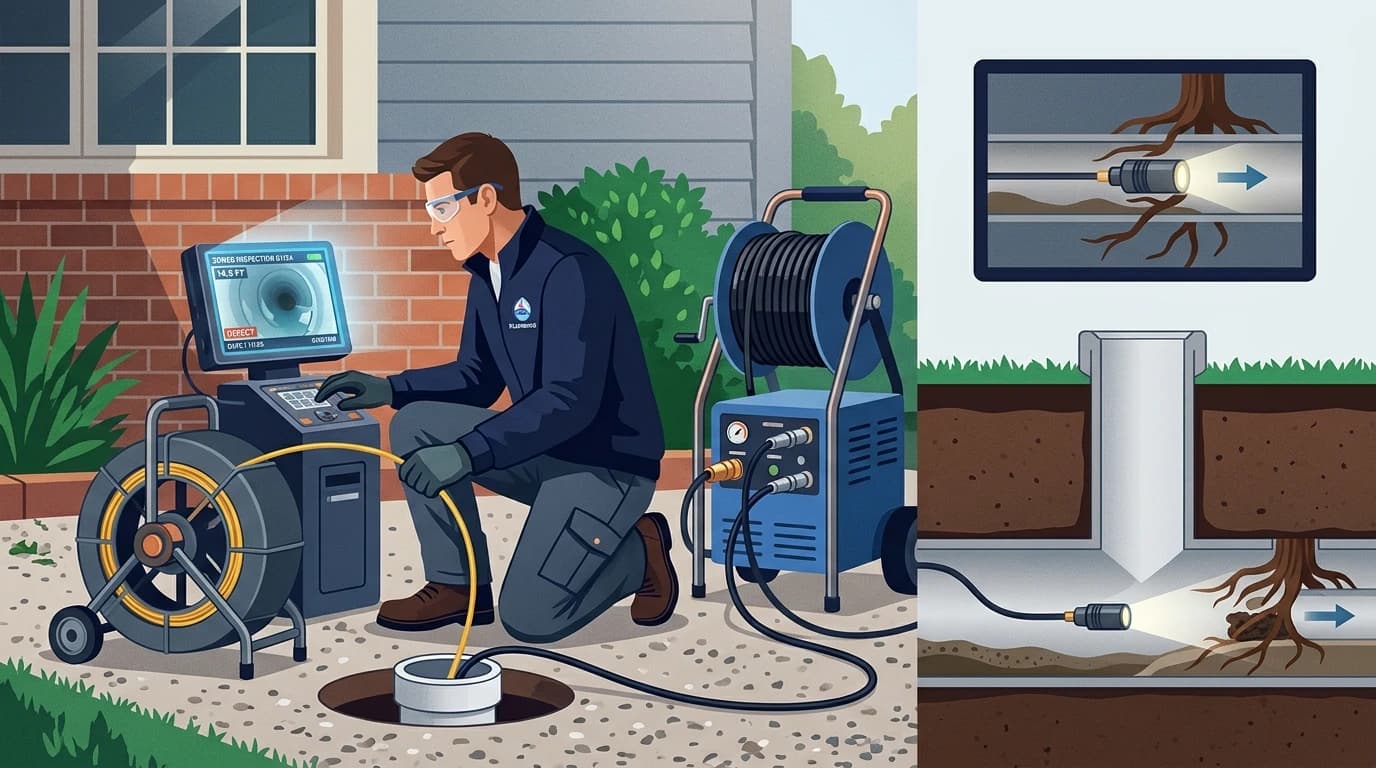
Optical push-camera calibration and cleanout access
A defensible sewer inspection begins with proper optical calibration and choosing the correct access point. Always access the lateral through an exterior two-way cleanout or ground-level cleanout rather than pulling an interior toilet whenever possible. Pulling toilets introduces unnecessary porcelain scratch liability, creates unbillable reset time, and restricts the push-rod's turning radius through the closet bend.
Before feeding the camera head down the riser, zero the electronic distance counter at the cleanout collar. Turn on the self-leveling optical head and confirm that the onboard 512 Hz sonde transmitter is operating by verifying the signal with your handheld pipe locator above ground. Document the cleanout baseline elevation, pipe material transition, and approximate burial depth before advancing the rod.
Keep a steady, controlled push rate of roughly one to two feet per second. When the camera lens hits grease smears or standing waste, run a light trickle of clear domestic water from an upstream laundry or hose bib. Clear running water lubricates the push-rod, keeps the camera head centered in the invert, and immediately highlights line sags or reverse grading.
Lateral defect classification and severity assessment
Accurately diagnosing underground sewer lines requires distinguishing between routine maintenance issues and structural failures. Misclassifying an isolated grease blockage as a collapsed lateral destroys homeowner trust and creates severe warranty exposure.
Document every defect with exact distance, clock orientation, and structural severity according to NASSCO PACP (Pipelogic / National Association of Sewer Service Companies) defect standards.
| Defect Type | Visual Pipe Markers | Likely Cause | Field Intervention |
|---|---|---|---|
| Bellies & Low Sags | Continuous lens submersion in still water over 4+ linear feet | Soil settlement, uncompacted trench bedding, or expansive clay movement | Hydrojetting provides temporary relief; permanent correction requires re-grading or excavation. |
| Joint Offset / Misalignment | Exposed pipe lip, visible soil void, jagged lip obstruction | Differential settlement, ground heave, or failed elastomeric slip joints | Grade 1-2: root cutting and CIPP liner; Grade 3-4: localized point repair or pipe bursting. |
| Root Intrusion (Hairline to Taproot) | Hair-like fiber mats entering at 3, 9, or 12 o'clock joints | Vitrified clay or concrete joints leaking moisture into dry soil | Hydrojetting with rotating root nozzle, followed by chemical foaming herbicide or epoxy lining. |
| Longitudinal / Radial Fractures | Crack lines running along pipe invert or circumferential shears | Excessive surface vehicular loading, ground frost freeze, or structural fatigue | Trenchless CIPP relining if structural integrity remains; full pipe bursting if wall collapsed. |
| Channel Rot / Invert Erosion | Missing pipe bottom, water flowing directly on dirt or gravel bedding | Decades of sulfuric acid degradation in unlined cast iron laterals | Mechanical snaking punches through bottom; requires trenchless pipe bursting or full open-trench replacement. |
Hydrojetting operating parameters: PSI vs. GPM and nozzle geometry
Hydrojetting is the most effective mechanical cleaning method for residential and commercial sewer lines, but incorrect pressure or nozzle selection can blow seals, flood basements, or shatter aged clay tile. Pressure (PSI) cuts and dislodges obstructions, but volume (GPM) is what carries solids, emulsified grease, and gravel out of the pipe to the city main.
For residential 3-inch and 4-inch sewer laterals, the optimal operating envelope is 3,500 to 4,000 PSI at 8 to 12 GPM. Running small 2-to-4 GPM electric or light-duty pressure washers into a grease-choked line merely pokes small holes through the sludge without scouring the inner pipe circumference.
- Penetrating nozzle: 1 forward jet (15-degree cone) and 3 to 4 rear thrust jets (30-degree). Ideal for opening complete blockages and initial punch-throughs.
- Flushing / Descaling nozzle: 6 to 8 wide-angle rear jets (45 degrees) with no forward jet. Maximizes pipe wall scouring and debris evacuation toward the city main.
- Rotating / Root-cutting nozzle: Mechanically driven rotating water blades (3,500 PSI) that shave taproots flush against the pipe wall without catching on joint offsets.
- Cornering / Trap nozzle: Ultra-short nozzle body engineered to navigate tight sweeps, sanitary tees, and P-traps without wedging.
Packaging unedited digital video reports for dispute-proof client trust
The biggest obstacle in selling necessary sewer repairs is consumer skepticism created by unscrupulous operators who use pre-recorded horror footage or exaggerate minor root hairs. Delivering unedited, cloud-hosted inspection footage with voiceover commentary eliminates suspicion and converts diagnostics into authorized repairs.
Record every inspection in 1080p high definition with on-screen text overlays displaying the property address, date, exact timestamp, and linear distance counter. Narration should remain strictly objective: state the pipe material, transition points, observed defects, and distance rather than using dramatic or alarming adjectives.
Provide the property owner with a permanent digital video link within thirty minutes of completing the service call. Include clear frame-grab still photos highlighting the exact defect alongside your itemized proposal on PlumberPick. When clients can share an unedited, clear inspection video with spouses, insurance adjusters, or co-owners, proposal acceptance rates increase dramatically.
Safety protocols and mandatory stop-work conditions
Experienced plumbing technicians know when to stop mechanical cleaning and advise trenchless or open-cut replacement. Forcing a high-pressure jet hose or heavy-duty cable past a severe structural obstruction often results in stuck equipment that requires emergency excavation to retrieve.
Stop work immediately if you encounter severe pipe collapse where soil or crushed tile completely blocks the path. Stop if you identify Orangeburg (bituminized fiber) pipe showing ovalization or delamination; mechanical blades will shred the fiber wall and completely destroy the conduit. Never operate hydrojetters in lines containing active commercial chemical drain cleaners without full chemical-resistant personal protective equipment.
Review your municipal sewer tap requirements and local right-of-way regulations before undertaking repairs past the property line. For contractors scaling their lateral repair operations, verify your licensing, insurance certifications, and service dispatch boundaries in our plumbing service area routing guide.